

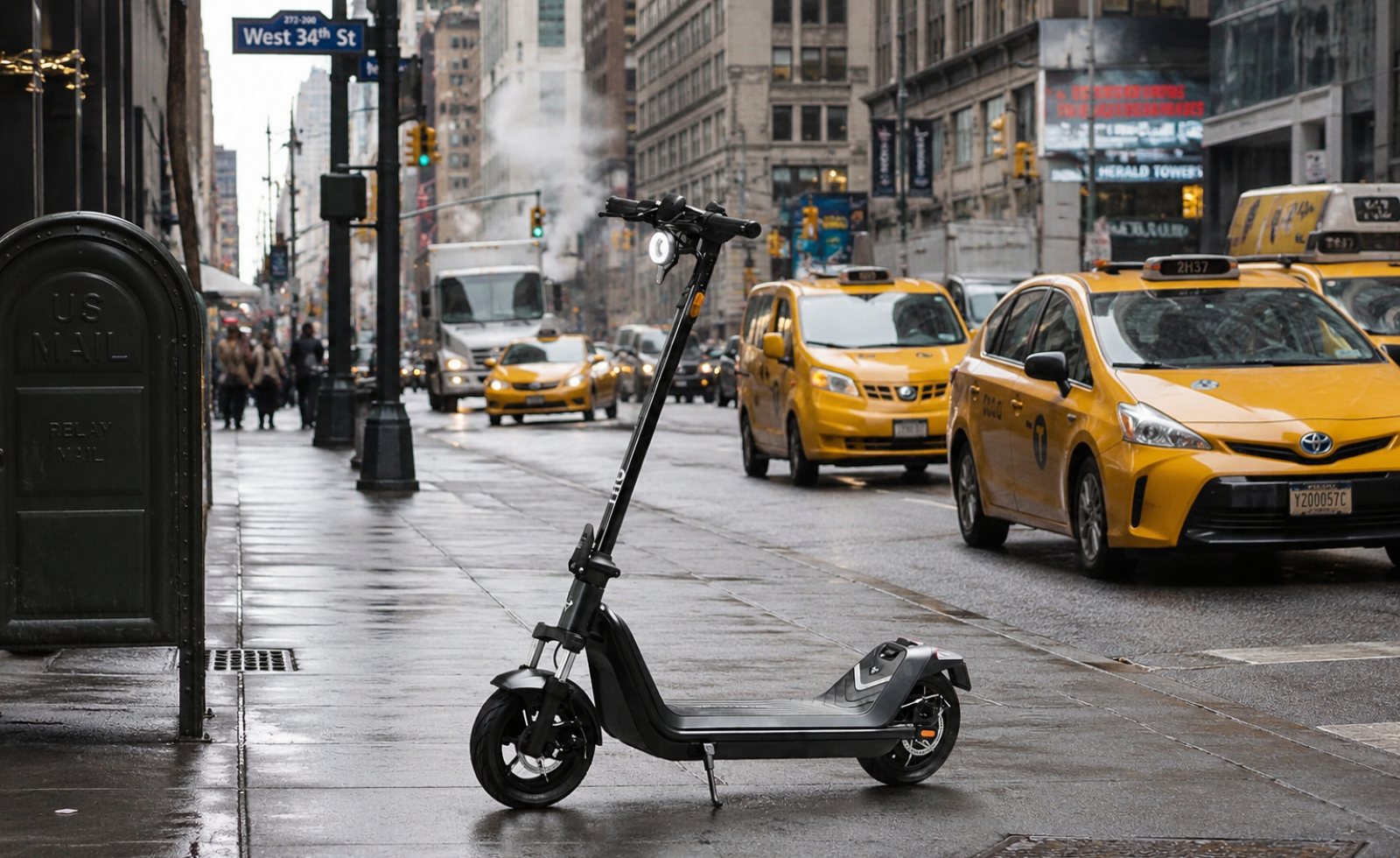
Quick verdict: NIU KQi 300P
The NIU KQi 300P is a comfort-first commuter scooter with a standout feature set for the money when it’s discounted: hydraulic suspension, wide 10.5-inch tubeless tires, turn signals, and dual disc brakes with regen. It rides calmer and more “grown-up” than most sub-$1,000 single-motor commuters.
The trade-offs are the ones commuters feel immediately: it’s not light (about 46 lb), it’s capped at 20 mph, and owner chatter is mixed on reliability/support outcomes (some smooth warranty experiences, some frustrating ones). Also, published battery capacity varies by listing, so I treat range expectations conservatively.
Real-world specs (what matters in daily riding)
- Top speed: 20 mph
- Motor: 450 W rated / up to 900 W peak (single motor)
- Claimed range: commonly listed as 30 miles (some retail pages market higher figures)
- Battery: 48 V system; capacity is listed as either ~486 Wh (manufacturer store listing) or 13 Ah / 608 Wh (major retailer listings). In practice, plan range based on riding style, not the biggest marketing number.
- Weight: ~45.97 lb
- Max rider weight: 265 lb
- Tires: 10.5-inch tubeless (marketed as self-healing on some listings)
- Brakes: dual disc (front + rear) + regenerative braking
- Suspension: dual-tube hydraulic suspension, ~45 mm stroke
- Water resistance: IP55 (water-resistant, not waterproof)
- Safety features: headlight, tail light, side reflectors, and integrated turn signals
- App features: NIU app connectivity, lock/unlock features, customizable ride settings (speed limits, acceleration sensitivity, charging limit)
Ride quality: why the KQi 300P feels “premium commuter”
This is where the 300P earns its reputation. The combination of hydraulic suspension and wide 10.5-inch tires is exactly what I want for imperfect U.S. streets—expansion joints, patched asphalt, and driveway lips. Instead of constantly bracing for chatter, I can stay relaxed and hold a steady line.
Handling is more stable than small-tire, no-suspension scooters. The wide contact patch helps it feel planted at 18–20 mph, and the turn signals are genuinely useful in traffic (still use hand signals when safe, but the extra visibility is nice).
Range and battery: what to expect in the real world
NIU markets commuter-friendly range numbers, but owners commonly report a much smaller number when riding fast (near 20 mph), dealing with frequent stops, using the headlight, riding in wind, or carrying more weight than the test rider. That’s normal for this class, but it surprises first-time buyers.
My practical planning advice: if your commute is 5–8 miles each way and you want to ride mostly at the top end (18–20 mph), treat the 300P as a “charge daily” scooter. If you need truly long range without babying the throttle, you’ll likely want a larger-battery commuter model (or step up to something like a Segway Max-class scooter).
Battery listings vary: some sources list roughly 486 Wh while others list 608 Wh. Because that discrepancy exists, I recommend planning range conservatively and choosing the 300P more for comfort and braking confidence than for headline mileage.
Speed and hills: capable, but not a hill monster
The 300P is a 20 mph scooter with a single motor. For typical city grades it’s fine, but it’s not designed to blast up steep hills at full speed. NIU claims up to about a 20% climb under specific conditions, and owners have reported the scooter going into protective behavior (overheat/overload-style errors) when pushed hard or under certain fault conditions.
If your route includes sustained steep climbs and you weigh closer to the max payload, you should consider a dual-motor scooter—or at least a stronger single-motor alternative known for hill torque.
Portability (and why weight matters more than you think)
At roughly 46 lb, this is not the scooter I’d want to carry up stairs every day. I can lift it into a trunk, but it’s a “two hands and plan the motion” kind of lift, not a grab-and-go. If your commute requires frequent carrying (walk-ups, subway stairs), you’ll feel this weight fast.
If portability is your #1 priority, lightweight options exist—but you usually give up suspension comfort and braking confidence to get there.
Safety and braking: strong commuter setup
Dual disc brakes plus regenerative braking is a commuter-friendly combo. Disc brakes bring consistent stopping power, while regen can help with control in stop-and-go riding. The lighting package and integrated turn signals are a big plus for dusk riding and urban visibility.
Commuter tip: keep your braking predictable. Use regen as a helper, but rely on the discs for decisive stops—and periodically check pad wear and rotor alignment.
Tires and maintenance: tubeless convenience, still needs checks
The 10.5-inch tubeless tires are one of the best day-to-day features on the 300P. Tubeless setups generally reduce pinch-flat headaches and can be easier to seal (especially if the tire is truly self-sealing as some listings claim). Still, commuters should do the basics:
- Check tire pressure weekly (low pressure kills range and makes flats more likely).
- Inspect tread and sidewalls after curb hits or potholes.
- Keep rotors true and calipers aligned to avoid rub (which also hurts range).
Reliability and support/parts notes (what owners are actually dealing with)
Owner reports are a mix. Many riders have good experiences and describe the 300-series as a meaningful upgrade from older NIU commuters, especially in ride comfort. But there are also posts about early-life faults (for example: scooters not powering on, error codes, wiring/throttle-related issues, and protective shutdown behavior).
On support, NIU advertises a 2-year warranty on major components. That’s a major selling point. In the real world, owners report both outcomes: some say warranty service was smooth and returned scooters in like-new condition; others report claim denials, slow communication, or confusion over what’s covered. The safest assumption is: warranty can be valuable, but you should keep packaging, document issues with photos/video, and avoid modifications that could complicate a claim.
Parts reality: like many sealed commuter scooters, battery replacement isn’t typically a simple “buy a spare and swap” situation. Plan on charging at home/work rather than treating it like a hot-swappable battery system.
Price and value in the United States
Value depends heavily on price. At full MSRP-ish pricing, you’re cross-shopping some very strong competitors. But the KQi 300P has been widely discounted (including direct-from-brand sales), and at those sale prices it becomes one of the better “comfortable 20 mph commuters” for the dollar—mainly because you’re getting suspension + wide tubeless tires + turn signals + dual discs in one package.
If you find it around the mid-$400s to mid-$600s, it’s compelling. If it’s closer to $850–$1,000, I’d be much more likely to choose a proven long-range commuter instead.
NIU KQi 300P alternatives (what I’d cross-shop)
- Segway-Ninebot Max G2: the default “durable commuter” alternative with strong real-world range reputation; great if you want a set-it-and-forget-it feel.
- NIU KQi 300X: if you like the 300P vibe but want more speed/range headroom (typically higher cost and heavier).
- Lighter portability picks: if you must carry your scooter daily, consider a lightweight commuter model—even if it means giving up some suspension comfort.
Who should buy the NIU KQi 300P
- Daily commuters who want a stable, comfortable 20 mph ride on rough pavement.
- Riders who value turn signals, good lighting, and dual disc braking for traffic riding.
- Buyers who can get it at a strong sale price and want maximum features per dollar.
Who should skip it
- Anyone who must carry a scooter up stairs daily (46 lb gets old fast).
- Riders who need serious hill performance at speed (look for more power or dual motors).
- People who want a simple ownership loop with easily purchased spare batteries and widely available parts.
- Range-sensitive commuters who need reliable 20+ mile real-world days at near-top speed without charging.
Final verdict: NIU KQi 300P
If you buy the NIU KQi 300P for what it is—a comfort-forward, safety-feature-rich 20 mph commuter—and you price it right, it’s an easy scooter to enjoy. The suspension + wide tubeless tires make everyday streets less punishing, and the braking/visibility package feels thoughtfully commuter-first.
Just go in with realistic expectations: real range at 20 mph is typically far below the biggest marketing numbers, portability is limited by weight, and support experiences vary enough that you should keep your documentation and avoid questionable mods. For most practical U.S. commutes in the 3–10 mile range (each way), it’s a strong choice—especially on sale.
FAQ
How fast does the NIU KQi 300P go?
It’s a 20 mph scooter in the U.S. That makes it ideal for bike-lane commuting, but it won’t satisfy riders looking for 25+ mph speed.
What real-world range can I expect from the NIU KQi 300P at 20 mph?
Plan conservatively. At near-top speed with stops, wind, and typical rider weights, many riders see roughly “commute range” rather than the biggest advertised number. If you need long days without charging, look at larger-battery commuter models.
Does the NIU KQi 300P have suspension?
Yes. It uses a dual-tube hydraulic suspension system (marketed around a 45 mm stroke), which is a major reason it feels comfortable on rough pavement.
Is the NIU KQi 300P good on hills?
It can handle moderate hills, but it’s still a single-motor 20 mph commuter. Steep or long climbs will slow it down, especially with heavier riders or low battery.
How much does the NIU KQi 300P weigh?
About 45.97 lb. It’s liftable into a trunk, but it’s not a great choice if you must carry a scooter up stairs every day.
Are the NIU KQi 300P tires tubeless, and are they self-healing?
The 300P is widely listed with 10.5-inch tubeless tires, and some retailer listings market them as self-healing. Even with tubeless tires, keeping proper pressure is key for range and puncture resistance.
Is the NIU KQi 300P water-resistant?
It’s rated IP55, which is water-resistant against light rain and splashes. It’s not waterproof, and sustained wet riding or deep puddles can still cause problems.
Does the NIU KQi 300P have turn signals?
Yes, integrated turn signals are part of the 300P’s commuter safety package, along with front and rear lighting and reflectors.