

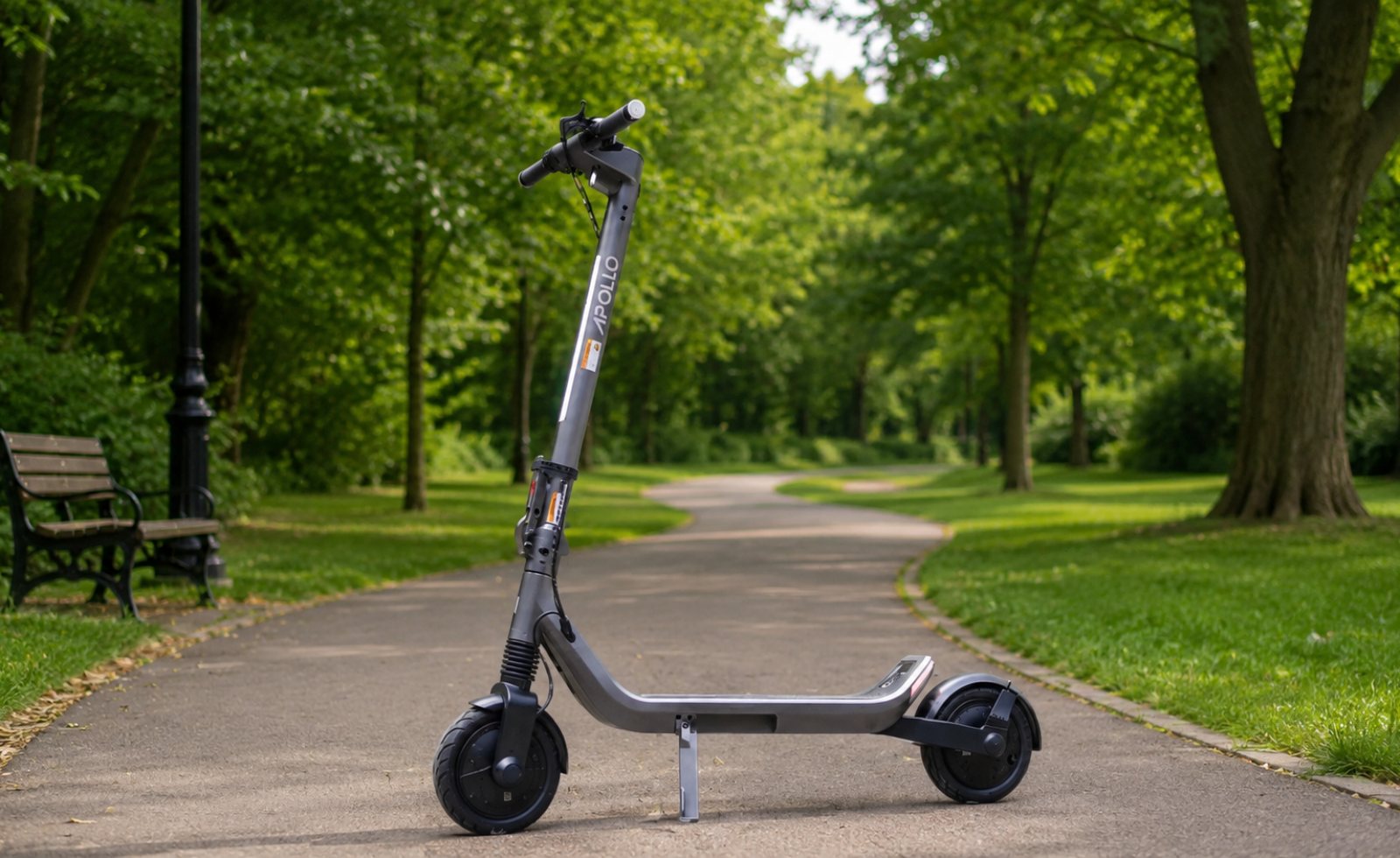
Quick verdict: Is the Apollo Go worth it?
The Apollo Go is one of the most convincing “premium commuter” scooters in the U.S. because it combines dual-motor punch, a surprisingly composed ride for its size, and a feature-rich app (regen tuning, acceleration tuning, cruise control behavior, turn-signal behavior). In normal commuting, the Go feels like a smaller, simpler version of a high-end scooter—quick off the line, confident on moderate hills, and easy to live with day to day.
The trade-offs are also real: it’s still 46 lb (portable, but not “one-hand effortless”), charging is on the slow side compared with some competitors, and Apollo’s reputation for support and parts experiences is mixed—some owners report smooth warranty outcomes, while others report delays, inconsistent responses, or friction around wear items.
Apollo Go real-world specs (what matters for commuting)
- Top speed: up to ~28 mph advertised (real-world tests often land closer to the mid/high-20s depending on rider weight, battery %, and conditions)
- Real-world range: expect roughly ~15–24 miles depending on speed and riding style; high-speed riding pulls that number down fast
- Weight: about 46 lb
- Motor setup: dual motors (commuter-oriented, with strong acceleration for its class)
- Tires: tubeless self-healing pneumatic tires (a big quality-of-life perk if they work as intended)
- Braking: strong regenerative braking plus a rear drum brake (low-maintenance mechanical brake style)
- Water resistance: commonly listed as IP66 for the scooter (still: use common sense in heavy rain / standing water)
- App/features: acceleration tuning, regen tuning, speed limiting, cruise control behavior, turn-signal behavior, and OTA-style feature updates (feature set varies by model year/firmware)
Note on range: Manufacturer max-range claims assume ideal conditions. Independent range tests and owner experiences generally land closer to commuter-realistic numbers—especially if you ride near top speed.
Ride quality: suspension and stability
For a compact commuter with dual motors, the Apollo Go’s ride is more composed than I expected. It’s not “floating” like big dual-suspension 10–11" performance scooters, but it takes the edge off typical city chatter—cracks, patched asphalt, curb cuts—and keeps the deck from feeling like a jackhammer.
What I like most in everyday riding is the control: the Go feels planted when I’m accelerating into traffic gaps, and predictable when I’m scrubbing speed approaching intersections. That predictability matters more than raw speed for commuting.
Range and battery: what I’d plan for
In the real world, I’d plan trips around a conservative range estimate. If you cruise closer to 14–18 mph and keep hard launches to a minimum, the Go can deliver a satisfying commute buffer. If you ride like it’s a mini performance scooter—fast starts, 22–28 mph cruising, lots of stops—range drops quickly.
The Go’s battery format is positioned as a premium choice, but the bigger day-to-day reality is: speed costs range. The Go tempts you to ride fast because it’s stable and punchy, so it’s on you to decide whether you want “fun mode” or “commute mode.”
Speed and hills: the main reason to buy the Go
This is where the Apollo Go earns its keep. Dual motors in a commuter-sized scooter make a noticeable difference in:
- Getting up to speed quickly from a stop (safer in some traffic situations)
- Holding speed on inclines that make single-motor commuters feel anemic
- Maintaining momentum when the route is rolling, not flat
That said, don’t expect a perfect 28 mph all the time. Many scooters (including this one) will feel strongest at higher battery percentages, and will taper as voltage drops.
Portability: 46 lb is “manageable,” not “light”
I consider 46 lb the upper edge of what I’m willing to carry regularly. One flight of stairs? Fine. Two flights daily? You’ll feel it. Public transit plus stairs plus office carry? It’s doable, but it’s not fun.
If your life involves frequent lifting (walk-ups, subway stations without elevators), you may be happier with a lighter single-motor commuter—even if it gives up hill performance.
Safety and braking: regen + drum is commuter-friendly
The braking setup is very commuter-oriented. The Go leans on regenerative braking (which you can typically tune) and backs it up with a rear drum brake. Drum brakes aren’t “sexy,” but they’re a low-maintenance choice that tends to handle wet/dirty city riding better than some exposed systems.
My main advice: spend time dialing in regen strength so it matches your routes. Too strong can feel grabby; too weak means you’ll rely more on the mechanical brake than necessary.
Tires and maintenance: self-healing helps, but flats still happen
The Go’s tubeless self-healing tires are a major selling point. In theory, small punctures seal themselves, which is exactly what I want on a commuter that I depend on to get to work.
Realistically, you still need to:
- Check tire pressure weekly (low pressure kills range, grip, and tire life)
- Inspect for embedded debris after rough rides
- Understand warranty coverage: many brands treat tires as wear items, and owners sometimes get surprised when a “tire problem” is handled as maintenance, not warranty
Reliability, support, and parts in the United States
Apollo’s support reputation is mixed enough that I treat it as part of the purchase decision—especially if this is your main transportation.
- Warranty baseline: Apollo commonly advertises a 12-month limited warranty policy for scooters (read the exclusions carefully, especially wear items and shipping responsibilities).
- Common owner themes (good): some riders report responsive support, warranty parts supplied, and issues resolved—especially when providing clear video proof and serial details.
- Common owner themes (bad): others report slow timelines, inconsistent communication, shipping delays, or frustration getting specific parts quickly.
My practical take: if you’re comfortable doing small DIY tasks (tightening, adjusting brakes, basic checks) and you’re patient with support processes when something goes wrong, the Go can be a great commuter. If you need “walk into any shop and get it fixed same-day,” a Segway/Ninebot ecosystem scooter may be a lower-stress ownership experience in many U.S. cities.
Apollo Go value and pricing context (U.S.)
Pricing on the Apollo Go in the U.S. can swing widely depending on promotions and retail channels. I’ve seen it listed around the upper hundreds on sale at big-box retail, while MSRP-style pricing can be much higher. The Go makes the most sense when you buy it at a meaningful discount, because that’s when it undercuts some heavier “performance” models while still delivering dual-motor commuting benefits.
If you’re paying near full MSRP, I’d comparison-shop hard against strong competitors with proven parts availability and service ecosystems.
Best alternatives to the Apollo Go (what I’d cross-shop)
- Segway Ninebot Max G2: a benchmark commuter choice with broad adoption; usually less punch than dual motors, but often lower ownership stress.
- NIU commuter models (like KQi series / similar): value-focused commuters with strong everyday usability; typically not as quick on hills as the Go.
- VMAX/other “premium single motor” commuters: for riders who want refinement and reliability more than max acceleration.
- Lightweight commuters: if you carry daily, prioritize weight over dual motors—even if it means slower hill climbs.
Who should buy the Apollo Go?
- You want dual-motor commuting without stepping into a huge, heavy scooter class.
- Your route includes real hills and you’re tired of single-motor bog-down.
- You value app customization (acceleration/regen behavior, cruise, speed limits, turn signals).
- You want a scooter that feels premium and stable at higher commuter speeds.
Who should skip the Apollo Go?
- You must carry up stairs daily and want something genuinely easy to lift.
- You want the simplest ownership experience with the largest service/parts ecosystem available locally.
- You expect to ride near top speed most of the time and still want long range—physics will disappoint you.
- You’re very risk-averse about support variability and don’t want to troubleshoot or wait on parts if needed.
Final verdict
If your priority is a fast, capable commuter—especially for hills—without buying a bulky performance scooter, the Apollo Go is a strong pick in the U.S. market. I’d buy it for the dual-motor feel, the controllable braking/acceleration, and the overall “refined commuter” vibe. I’d go in with clear expectations on real-world range, and I’d read the warranty terms closely so tire/wear-item surprises don’t sour the experience.
FAQ
How fast does the Apollo Go go in real life?
Apollo advertises up to 28 mph, but many real-world tests and owners report mid-to-high 20s mph depending on rider weight, wind, temperature, and battery percentage.
What real-world range can I expect from the Apollo Go?
Plan for roughly 15–24 miles in typical commuting. Riding faster (22–28 mph), using hard acceleration, and climbing hills will push range toward the lower end.
Is the Apollo Go good for hills?
Yes. The dual-motor setup is the Go’s biggest advantage—expect noticeably better hill speed and less bog-down than most single-motor commuter scooters.
How much does the Apollo Go weigh, and is it easy to carry?
It’s about 46 lb. Carrying it up a short set of stairs is manageable, but it’s not ideal for daily multi-flight walk-ups or frequent transit lifting.
Does the Apollo Go have suspension and is it comfortable?
Yes, it has a commuter-focused suspension setup that smooths out city roughness better than no-suspension scooters, though it won’t feel as plush as heavier performance models.
What kind of brakes does the Apollo Go have?
It relies on regenerative braking plus a rear drum brake. Regen can typically be tuned in the app, and the drum brake is a low-maintenance mechanical backup for reliable stopping.
Are the Apollo Go tires tubeless and self-healing?
Yes, it’s commonly listed with tubeless self-healing pneumatic tires. They can help seal small punctures, but you still need to maintain proper tire pressure and inspect for debris.
Is the Apollo Go water resistant for commuting in rain?
It’s commonly listed as IP66, which is strong for commuter use. Still avoid deep puddles/standing water, ride cautiously in wet conditions, and dry the scooter after heavy rain.