

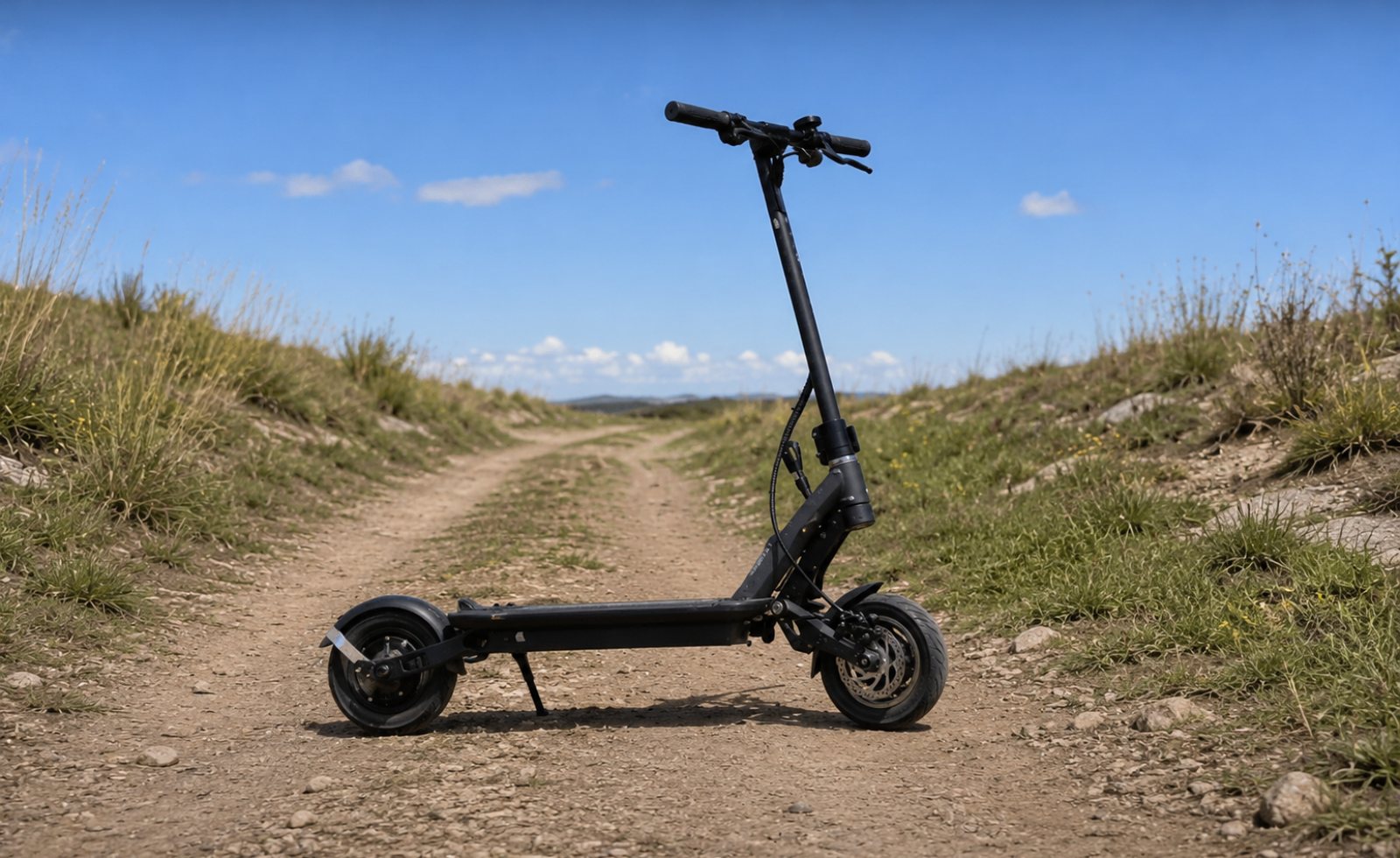
Quick verdict on the Nami Klima
If you want a seriously fast, suspension-first 10-inch performance scooter without jumping into 72V hyperscooter size/weight, the Nami Klima is one of the easiest picks in its class. The standout is how “big scooter” it feels: strong pull, composed suspension, and a planted chassis that encourages confident speed.
The trade-offs are the usual high-performance reality: it’s heavy, it’s not something I’d want to carry up stairs daily, and owner chatter consistently points to electronics quirks (display/brake sensor type issues) and support variability depending on who you bought it from. Buy it from a reputable US retailer with real parts support, and you’ll enjoy the Klima a lot more.
Nami Klima real-world specs (what matters day to day)
- Motors: Dual 1000W hub motors (high-output performance tune)
- Battery: 60V 25Ah (~1500Wh) base; also sold in higher-capacity variants depending on market/version
- Controllers: Dual 40A controllers (strong acceleration and hill performance)
- Top speed (typical US spec context): about 42 mph class depending on settings, rider weight, and conditions
- Claimed range: often marketed around 50 miles (base battery) in ideal conditions; real-world is usually meaningfully less
- Suspension: Adjustable hydraulic suspension (KKE), long-travel feel for the category
- Brakes: Hydraulic disc brakes (140 mm, 2-piston)
- Tires: Tubeless CST 10-inch “road” tires (a major practical win)
- Water resistance: commonly listed as IPX5 for the body with higher-rated display/controller protection (still: treat as splash resistance, not “ride through storms”)
- Weight: roughly 37–38 kg (about 83 lb class, depending on version)
Note on versions: the Klima line can vary (battery capacity, sometimes component revisions). I recommend confirming the exact battery (Ah/Wh), tire size listing, and included charger with the retailer listing for the unit you’re actually buying.
Ride quality: why the Klima feels like a “premium” ride
This is where the Klima earns its reputation. The tubular frame + long-travel hydraulic suspension gives it a calm, controlled ride over broken pavement that a lot of 10-inch performance scooters struggle with. When the road gets ugly—patchwork asphalt, expansion joints, rough bike lanes—the Klima stays composed instead of chattering you to death.
It also has that “one solid piece” vibe at speed. The deck is stable, the steering feels predictable once you get your setup dialed, and the scooter encourages you to ride smoothly rather than constantly correcting.
Range and battery: what I’d realistically expect
The base 60V 25Ah pack is a strong size for this performance class. That said, if you ride the Klima the way it begs to be ridden (hard launches, fast cruising, lots of speed changes), expect your range to drop fast compared to marketing claims.
- Efficient cruising (slower): you can plan for long rides, but you’ll need discipline on speed
- Mixed real-world riding: think “commute pace + fun bursts” rather than constant max
- Aggressive performance riding: range becomes the cost of admission
Practical owner advice: keep tire pressure up, avoid storing the battery at 100% for long periods, and don’t fast-charge a hot pack right after a hard ride. Those habits matter more on high-output scooters than most people realize.
Speed and hills: the Klima’s core strength
Acceleration is the Klima’s party trick. Dual motors plus strong controllers deliver real shove—the kind that makes you adjust your stance and pay attention. If you’re stepping up from a commuter scooter, the first few launches will feel like a different sport.
On hills, the Klima is one of those scooters where I don’t have to “plan” for the climb. It just goes—especially if you’re comfortable using the higher modes and you’re not trying to baby the throttle.
Important: with great power comes great responsibility. If you don’t have experience braking hard from high speed or managing traction at launch, learn gradually.
Portability and weight: this is not a lightweight commuter
At roughly the low-80 lb class, the Klima is carryable in the sense that you can lift it into a trunk or up a few steps. But I wouldn’t call it convenient. If your daily life includes stairs, tight storage, or frequent carrying, the Klima will feel like a commitment.
- Good for: garage storage, ground-floor apartments, rolling into elevators, loading into a vehicle
- Not great for: multi-floor walkups, bus/train carry, small closet storage
Safety and braking: strong hardware, but check your setup
Hydraulic discs with 140 mm rotors are absolutely the right braking hardware for this speed class, and the stopping power is there. The key is setup and maintenance: rotor alignment, pad bedding, and lever feel matter a lot.
From owner discussions, the Klima ecosystem has also seen reports of brake sensor/electronic brake cutout quirks (more common as “out of the box” or early-life annoyances than as a permanent flaw). If a scooter is “bricking,” cutting power, or behaving strangely around braking inputs, that’s a support ticket—not a DIY ride-it-out situation.
Tires and maintenance: tubeless is a real-world win (with a learning curve)
The Klima’s tubeless setup is a big reason people cross-shop it versus tube-based options. Tubeless typically means fewer pinch flats and easier puncture management (sealant can help, depending on the hole).
But tubeless comes with its own reality: if you run pressure too low, you can unseat a bead—especially on hard hits. I treat tire pressure checks as part of my routine (like chain lube on a bike). It’s boring, but it prevents the scary stuff.
- What I’d do immediately: set correct PSI for your weight, add sealant if you know how (or have a shop do it), and carry a plug kit
- What I’d watch for: sidewall cuts, slow leaks, and bent rotors after impacts
Features: NFC, modes, and the stuff you’ll actually use
The NFC start system is a nice “daily convenience” feature: it’s quick and it reduces casual tampering. The riding modes and tunability are more important—because the Klima has enough power that you’ll likely want to customize throttle response and ramp to match your skill level and riding environment.
I also like having real lighting and turn signals on a scooter that can mix with traffic speeds. Still, I treat scooter turn signals as “better than nothing” rather than a replacement for clear hand signaling and smart lane positioning.
Reliability, support, and parts in the United States
My take from the wider owner landscape is pretty consistent: the Klima is a phenomenal ride, but your ownership happiness depends heavily on purchase channel and after-sale support. The most repeated complaints revolve around:
- Display issues: intermittent behavior or replacement costs (and some owners note mileage can reset with a new display)
- Early electronics quirks: brake sensor / error code type events after shipping or early use
- Warranty expectations: some owners report smooth help through reputable retailers; others report frustration when warranty responsibility is unclear
If you’re in the US, I strongly prefer buying from a retailer known for stocking parts and actually handling support cases, rather than treating you as an international middleman case. Also: plan to do basic performance-scooter upkeep (bolt checks, tire pressure, brake inspection). This isn’t a “set it and forget it” appliance scooter.
Nami Klima alternatives (what I’d cross-shop)
VSETT 10+
If you want a classic, aggressive performance scooter platform with lots of community knowledge and parts availability, the VSETT 10+ remains a common alternative. Many riders still love its raw performance, but you give up the Klima’s tubeless convenience and some of the “premium suspension feel” depending on your setup and version.
Kaabo Wolf Warrior X (or X GT depending on year/trim)
If you prioritize stability and a “dual-stem” style ride feel, Kaabo’s Wolf line is often the other major option in this speed/weight bracket. It can feel more like a rugged mini-beast, while the Klima feels like a refined performance street machine.
NAMI Burn-E (if you’re thinking bigger)
If you’re already telling yourself you want more speed, more battery, and more “hyper scooter” presence, the Burn-E family is the next step. But you’ll pay in money, size, and practicality.
Who should buy the Nami Klima?
- Riders who want serious acceleration and strong hill climbing without going full 72V monster
- Anyone who values ride comfort on rough pavement (suspension is a top-tier selling point)
- People who specifically want tubeless tires in the performance category
- Buyers who can store/handle an ~80+ lb scooter and will do basic maintenance
Who should skip the Nami Klima?
- If you need lightweight portability (stairs, frequent carrying, small storage)
- If you want a “no-maintenance, no-drama” appliance scooter
- If you don’t have a good local shop option and won’t buy from a retailer with strong US parts/support
- If your local laws or riding environment can’t realistically use performance capability safely
Final verdict: is the Nami Klima worth it in the US?
Yes—if you buy it for the right reasons. The Nami Klima is one of those scooters that makes me want to take the long way home: fast, planted, and genuinely comfortable for its class. Its biggest risk isn’t that it’s a bad scooter—it’s that performance scooters demand performance-scooter ownership habits, and support can be inconsistent if you buy from the wrong place.
If you want the “wow factor” without stepping into a huge 11–12 inch hyperscooter footprint, the Klima remains a top-tier pick.
FAQ
How fast is the Nami Klima in real-world riding?
Most US-facing specs and independent tests place it in the ~42 mph performance class (with rider weight, settings, and conditions making a noticeable difference).
What real-world range should I expect from the Nami Klima 60V 25Ah?
Plan for significantly less than the marketed “up to” numbers if you ride fast. Smooth, slower cruising extends range; hard launches and high speeds reduce it quickly.
Is the Nami Klima good for steep hills?
Yes. Dual motors plus strong controllers make it a confident hill climber, especially compared with commuter-class scooters.
Does the Nami Klima have tubeless tires, and are they worth it?
Yes—tubeless tires are a big practical advantage for puncture management and reducing pinch flats, but you still need to maintain proper tire pressure to avoid bead issues.
How heavy is the Nami Klima, and can I carry it?
It’s roughly in the ~83 lb class depending on version. You can lift it short distances, but it’s not convenient for daily stairs or frequent carrying.
Is the Nami Klima water-resistant enough for commuting in rain?
It’s commonly rated around IPX5 with higher protection for the display/controller, which helps with wet roads and light rain. Still treat it as splash-resistant and avoid deep water and storm riding.
What are the most common Nami Klima owner complaints?
Owner discussions most often mention occasional display issues, brake sensor/electronics quirks, and inconsistent warranty experiences depending on where the scooter was purchased.
Should I buy the Nami Klima from a US retailer or import it?
For most buyers, a reputable US retailer is the safer move because parts availability and warranty handling tend to be smoother than dealing with cross-border support.